Dạ, cho tôi hỏi...
Approx. pronunciation: ya, chaw toy hoy
Excuse me, may I ask...?
Language for getting around the southern city.
Learn the phrases, address words, and listening cues that help you order, navigate, and ask for a hand in Hồ Chí Minh City.
Start the city guide
Southern speech has useful listening patterns, but no city has only one voice.
In many southern accents, d and gi can begin with a y-like sound, and v may soften toward a y-like sound in quick speech. Many speakers also pronounce hỏi and ngã similarly in everyday conversation. You may hear these patterns in Hồ Chí Minh City, but individual speakers vary by family, age, neighborhood, and background. Keep the spelling in view and listen before you imitate.
A learner does not need to choose between “northern” and “southern” Vietnamese. Clear, respectful speech works across the country. When a word seems unfamiliar, ask the person to repeat it or type it into your phone. In a busy city, confirming the address is often more useful than trying to guess a sound from one syllable.
Two local address words are especially practical: hẻm means an alley or lane, often including branches, and đường means street or road. A number followed by hẻm may describe a turn inside a larger street address, so save the full written address and a nearby landmark when possible.
Use these short lines before asking for directions, service, or a recommendation.
Dạ, cho tôi hỏi...
Approx. pronunciation: ya, chaw toy hoy
Excuse me, may I ask...?
Cho tôi hỏi ạ.
Approx. pronunciation: chaw toy hoy ah
Excuse me, may I ask?
Dạ, cảm ơn ạ.
Approx. pronunciation: ya, gahm uhn ah
Yes, thank you.
Được không ạ?
Approx. pronunciation: duh-uk khom ah
Is that all right? / Can I?
A short ride becomes easier when you confirm the alley entrance and the final walking point.
You Dạ, cho tôi hỏi, địa chỉ này ở hẻm nào ạ? Excuse me, which alley is this address in?
Driver Hẻm này. Tới đầu hẻm tôi báo nhé. This alley. I will tell you when we reach its entrance.
You Dạ, cho tôi xuống ở đầu hẻm nhé. Okay, please let me off at the entrance of the alley.
You Bạn gửi giúp tôi vị trí trên bản đồ được không? Could you send me the location on the map?
Driver Được, tôi gửi ngay. Sure, I will send it now.
Build your order one choice at a time so you can hear what is being confirmed.
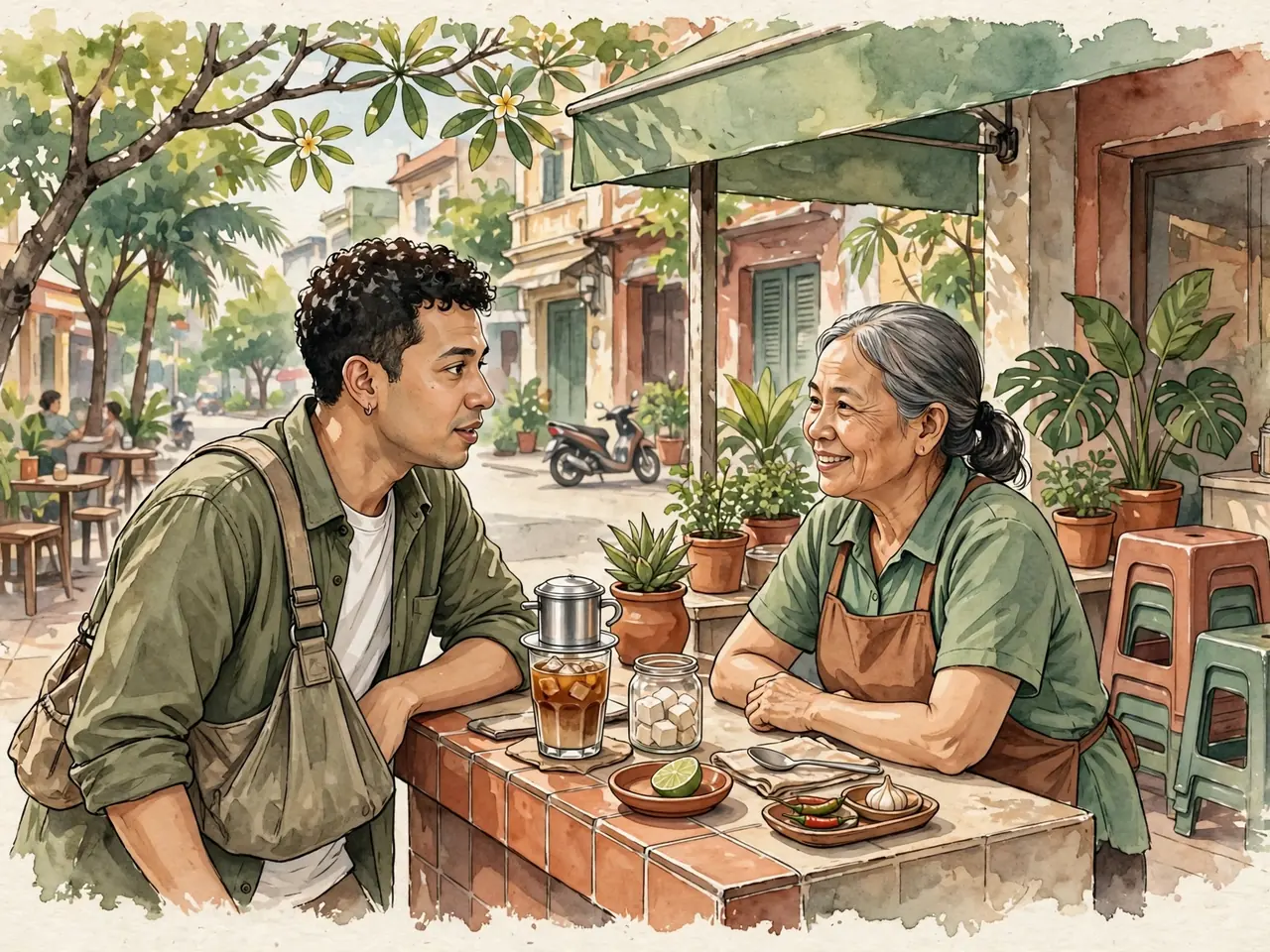
Cho tôi một ly cà phê sữa đá.
Approx. pronunciation: chaw toy moht lee kah feh suh dah
A glass of iced milk coffee, please.
Ít đá thôi ạ.
Approx. pronunciation: eet dah toy ah
Just a little ice, please.
Món này có cay không ạ?
Approx. pronunciation: mon nay kaw kai khom ah
Is this dish spicy?
Tính tiền giúp tôi với ạ.
Approx. pronunciation: ting tee-uhn zoop toy voy ah
Could I have the bill, please?
Politeness is more than a single regional word; it is a combination of relationship, tone, and timing.
In Hồ Chí Minh City, you will often hear dạ as a polite “yes” or as part of a respectful reply. In a common southern pronunciation it may sound closer to “ya,” while another speaker may keep a different onset. Cảm ơn nha is a friendly “thanks,” and nhé can soften a suggestion or request. Use these forms as you hear them, not as a performance of a stereotype.
For a straightforward order, Cho tôi... is clear and useful. To get someone’s attention, choose anh ơi or chị ơi when the relationship word fits; do not say both forms as one phrase. If the relationship is unclear, the greeting plus a map or menu gives you a safe starting point. Avoid assuming that a casual-sounding exchange means you should immediately use intimate pronouns.
When you need to change an order, say Xin lỗi, tôi muốn đổi món này, “Excuse me, I would like to change this dish.” Add the exact change after it. A calm, specific request lets the other person solve the right problem quickly.
Repeat the important item and quantity instead of relying on a vague correction.
You Xin lỗi, tôi gọi cà phê sữa đá, không phải cà phê đen ạ. Excuse me, I ordered iced milk coffee, not black coffee.
Staff Dạ, xin lỗi ạ. Tôi đổi ngay ạ. Sorry. I will change it right away.
You Cảm ơn. Cho tôi ít đá thôi nhé. Thank you. Just a little ice, please.
Staff Dạ, ít đá ạ. Yes, a little ice.
You Đúng rồi, cảm ơn bạn. That is right, thank you.
Repeat the same decision-making pattern in three different places.
At a café, greet the person, place one order, and repeat the choice you care about. On a walk, ask for the street or hẻm and save the answer in writing. Later, use one repair line such as Bạn nói chậm hơn được không?, “Could you speak more slowly?” These small repetitions train your ear to the city’s real pace.
Do not treat southern pronunciation as a set of rules that overrides spelling. A person from Hồ Chí Minh City may speak with a strong local accent, a mixed family background, or a more formal register. Your goal is comprehension: notice a y-like onset in a familiar word, check the written form, and ask when the meaning affects your decision.
Before leaving, practise this sequence aloud: Dạ, cho tôi hỏi...; Bạn chỉ trên bản đồ giúp tôi được không?; and Cảm ơn nha. It gives you an opening, a way to confirm the route, and a natural close without needing a long conversation.