Xin lỗi, cho tôi hỏi đường đến địa điểm này ạ.
Approx. pronunciation: sin loy, chaw toy hoy doong den dee-ah diem nay ah
Excuse me, could you tell me how to get to this place?
Find your way, one landmark at a time.
Learn friendly questions and route words for walking through a new neighborhood or city.
Start the lesson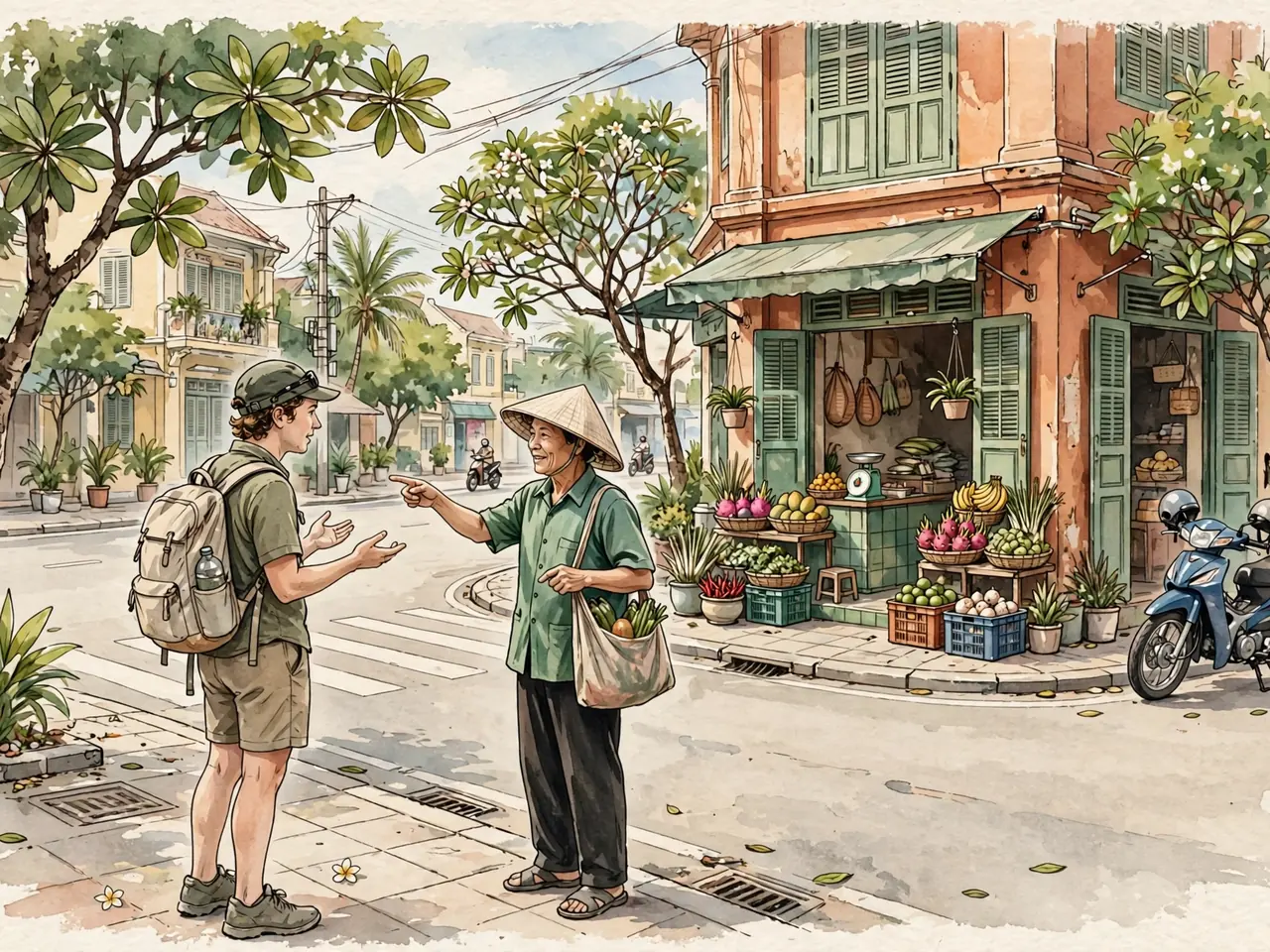
“Xin lỗi” gets attention politely. The phonetic hints are approximate cues for learners, not a full guide to Vietnamese tones.
Xin lỗi, cho tôi hỏi đường đến địa điểm này ạ.
Approx. pronunciation: sin loy, chaw toy hoy doong den dee-ah diem nay ah
Excuse me, could you tell me how to get to this place?
Bạn có thể chỉ đường giúp tôi được không ạ?
Approx. pronunciation: ban kaw thay chee doong zoop toy duck khom ah
Could you show me the way?
Địa điểm này ở đâu ạ?
Approx. pronunciation: dee-ah diem nay uh dow ah
Where is this place?
These short words often appear in spoken directions. Repeat the sequence back if you want to confirm it.
Đi thẳng.
Approx. pronunciation: dee tahng
Go straight.
Rẽ trái ở ngã tư.
Approx. pronunciation: zay try uh nga too
Turn left at the intersection.
Ở bên phải đường.
Approx. pronunciation: uh ben fy doong
It is on the right side of the road.
A visible place can make a direction easier to follow than a long address.

“Gần” means near, “đối diện” means opposite, and “bên cạnh” means next to. “Quán cà phê” is coffee shop, “chợ” is market, and “nhà thuốc” is pharmacy. Combine them: “Nhà thuốc ở đối diện ngân hàng” means “The pharmacy is opposite the bank.”
You may hear “hẻm” often in the south and “ngõ” often in the north for a small lane or alley. They refer to similar kinds of narrow streets; keep the local word you hear when repeating a route.
This exchange shows how to ask whether a destination is walkable and confirm the final turn.
You Cho tôi hỏi, bảo tàng có gần đây không ạ? Excuse me, is the museum near here?
Local Có. Bạn đi thẳng khoảng năm phút rồi rẽ phải. Yes. Go straight for about five minutes, then turn right.
You Sau đó bảo tàng ở bên trái, đúng không ạ? After that, the museum is on the left, right?
Ask one follow-up question before setting off, especially when the route includes several turns.
Từ đây đi bộ được không ạ?
Approx. pronunciation: tuh day dee boh duck khom ah
Can I walk there from here?
Còn xa không ạ?
Approx. pronunciation: kon sa khom ah
Is it still far?
Tôi đi đúng đường chưa ạ?
Approx. pronunciation: toy dee doong doong chuh ah
Am I going the right way?
A brief acknowledgment is enough; you do not need to hold a long conversation to be courteous.
Say “Cảm ơn bạn” to a peer-aged person, or choose “Cảm ơn anh” or “Cảm ơn chị” when that relationship word fits. If you are unsure, “Cảm ơn” alone is safe and friendly.
If you did not catch the answer, say “Bạn có thể nói lại chậm hơn một chút không ạ?” You can also show the destination on a map and ask “Đây có phải là chỗ này không ạ?” to check the place visually.